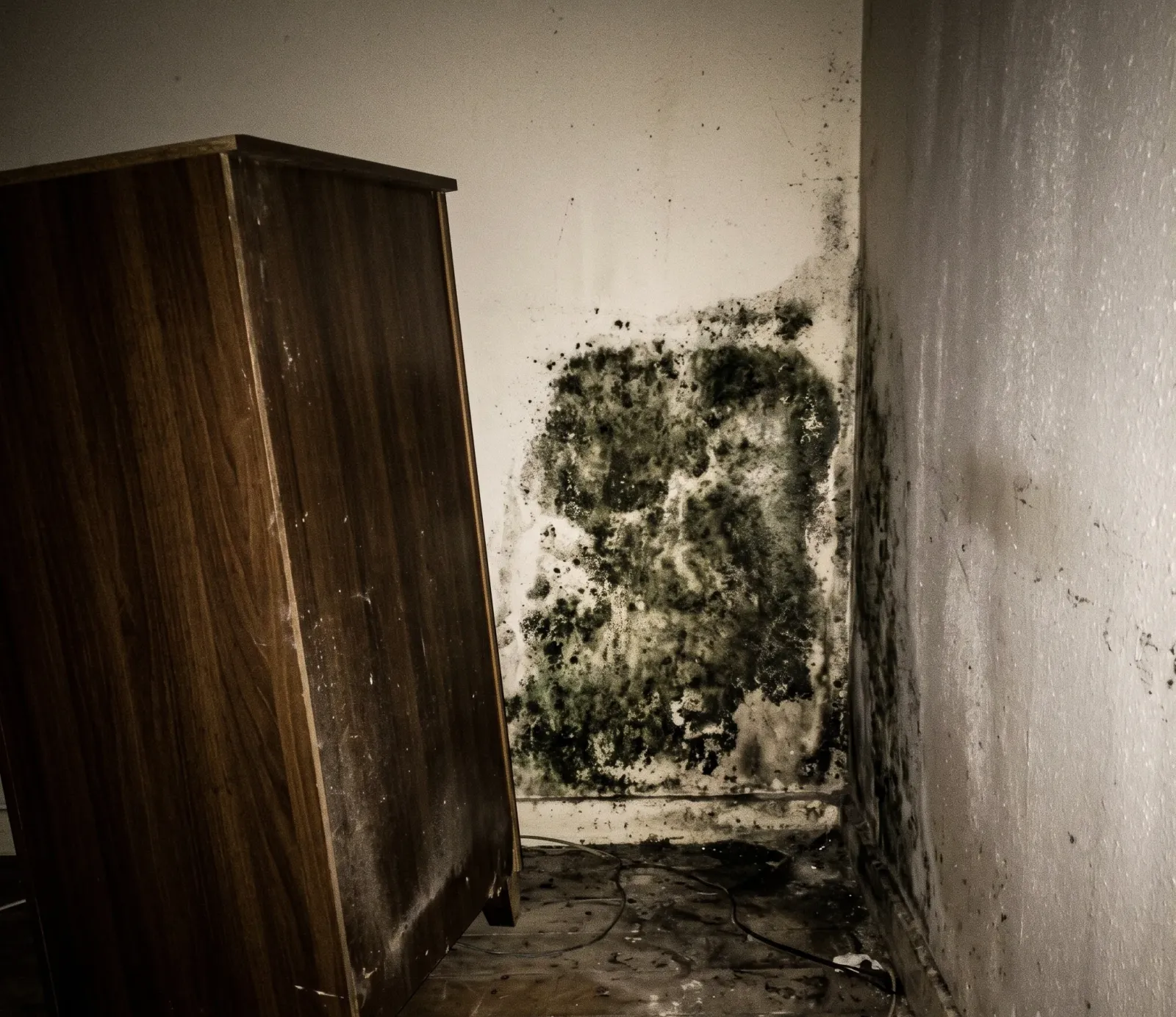
Why Mold Grows Faster in GA Homes
Why Atlanta's long humid season keeps damp building materials colonized for months at a stretch.
In Atlanta, mold grows year-round because summer humidity (roughly May through September) keeps indoor air moist enough that any damp material stays hospitable, and colonization can start in 24 to 48 hours once a surface is wet.
Why Humidity Drives Mold Here
Mold needs three things at once: a moisture source, organic material to feed on, and time. Atlanta supplies the middle two everywhere — drywall paper, wood framing, and dust are organic material in nearly every building — so the variable that decides whether a space grows mold is moisture. Relative humidity above roughly 60 percent, sustained rather than brief, is enough to keep surface moisture available for spores already present in ordinary indoor air. Colonization does not require a flood. It requires conditions that stay damp long enough for spores to establish and spread.
Vapor pressure is the real driver: warm air holds far more moisture than cool air, so Atlanta's stretch of subtropical afternoons pushes humid outdoor air toward every cooler indoor surface it can reach. A crawl space under a house near Peachtree Creek or a basement wall in a Grant Park bungalow behaves like a condensation target for months, not days. Once relative humidity near a wood joist or a sheet of drywall sits above roughly 70 percent for any length of time, that material stops being simply damp and starts being a growth medium.
That condensation cycle repeats every day of the humid season, not once. A crawl space under an Atlanta house with a torn or absent vapor barrier pulls ground moisture upward into space that is already carrying high ambient humidity, and the wood joists overhead sit in that combination for months. A basement wall showing efflorescence is telling the same story from the other direction — moisture moving through masonry and evaporating at the surface, leaving mineral residue behind. Neither needs a storm. Both are baseline conditions of living in this climate.
Relative Humidity and Vapor Pressure
An HVAC coil is one of the most reliable indoor condensation surfaces in any Atlanta home, because it is deliberately kept cold to remove heat from the air passing over it. Warm, humid air condenses on the coil by design, and that water is supposed to leave through the drain pan and condensate line. When the line clogs, the pan cracks, or the system's insulation fails, that water goes somewhere else instead — into the surrounding cavity, the attic platform under the air handler, or the ceiling below it. An attic air handler with a neglected drain pan is a common, quiet starting point for growth that nobody sees until it reaches the ceiling drywall.
Off-gassing is sometimes confused with mold odor, but they are different mechanisms worth separating. Building materials and finishes can release volatile compounds on their own; mold produces its own distinct musty smell as a byproduct of active microbial growth breaking down organic material. Both affect indoor air quality, but only one signals a moisture problem that needs finding. A persistent musty smell in a specific room — a finished basement, a hall closet backing onto an exterior wall — is usually the more useful clue than a visible stain, because smell often precedes visible colonization by weeks.
- Relative humidity, not temperature, is the number that matters. When indoor relative humidity sits above the mid-50s for stretches of time, organic material like drywall paper, wood framing, and dust holds enough moisture for spores already present in the air to begin colonization.
- Atlanta's dew points climb from roughly May through September, which raises vapor pressure indoors even in houses with working air conditioning. A crawl space under a home near Peachtree Creek or a basement close to the Chattahoochee River feels this first.
- Condensation forms wherever warm, moist air meets a cool surface. An HVAC coil running in a hot Atlanta attic, a cold water line in an unconditioned crawl space, or a poorly insulated duct in Buckhead or Decatur are common condensation points that go unnoticed for months.
- An HVAC coil that stays wet between cooling cycles is a quiet colonization site. Condensate should drain fully and the coil should dry between runs; a system oversized for a smaller Virginia-Highland bungalow short-cycles, drips more, and dries less, feeding microbial growth on the coil and in the plenum.
- An air handler's drain pan and plenum sit wet or damp for long stretches during humid months. If condensate does not drain properly, that moisture source sits inside ductwork that pushes air through the whole house.
- Efflorescence on a basement wall is a visible sign that moisture is moving through concrete or block from the soil side. Older homes near Grant Park or Inman Park with daylight basements show this along the below-grade wall face.
Where Moisture Actually Comes From
Once a colony establishes on a wet surface, it does not stay a flat patch of discoloration indefinitely. Growth can develop into a biofilm — a structured, adherent layer that holds moisture against the material it is growing on and makes the colony more resistant to surface cleaning. This matters for anyone tempted to wipe a moldy patch with a household cleaner and call it solved: a biofilm can persist beneath a cleaned surface and resume visible growth once conditions allow, because the underlying moisture source and the embedded growth were never actually removed.
A wet stud or a soaked pad of carpet does not wait for a diagnosis. Spores already present in ordinary household dust find a foothold within one to two days once a surface stays saturated, and colonization spreads outward from there rather than sitting still. This is why response speed matters more than almost anything else in the S500 framework: a crawl space vapor barrier that failed under a Buckhead or Decatur home, an attic air handler drain pan that backed up, or a basement wall weeping after a hard rain all start the same clock the moment the organic material in drywall paper or wood framing stays wet.
- Once colonization begins, mold does not stay put. It can produce a biofilm on consistently wet surfaces, and some growth produces a musty off-gassing that is often the first thing a homeowner in Kirkwood or Edgewood actually notices.
- Indoor air quality can be affected once mold is established, since spores and other byproducts become airborne and move through the same duct system the air handler uses to condition the rest of the house.
- Humidity control is the actual fix, not a one-time cleaning. A dehumidifier sized to the space, a sealed crawl space vapor barrier, or a repaired HVAC coil addresses the moisture source instead of just the visible growth on top of it.
- Atlanta's climate does not give a house an off-season. A basement near Candler Park or a crawl space near East Lake that stays humid in January is still a viable growth environment, just a slower one than in July or August.
Reading Your Own Humidity Numbers
Certain building conditions in Atlanta's housing stock make year-round growth more likely rather than less. Where full or daylight basements exist — common on the sloped, older lots found through neighborhoods like Grant Park and Virginia-Highland — foundation walls are commonly poured concrete or concrete masonry unit, and a daylight wall exposed at or near grade takes on both wind-driven rain and groundwater pressure that a fully buried basement wall does not. That combination of exposure and below-grade cooling makes daylight basement walls a recurring site for condensation and, eventually, colonization if the cavity behind the finish stays damp.
Attics present the opposite problem in the same climate. A poorly ventilated attic under an Atlanta roof traps warm, humid air against the underside of the roof deck, and that deck is often the coolest surface in the space overnight as it radiates heat back out. Condensation on sheathing and rafters can go unnoticed for a long time because nobody routinely inspects an attic, and the same space often houses an air handler whose plenum and drain pan are additional condensation and leak points sitting directly above living space.
| Location | Moisture Source | Risk Level |
|---|---|---|
| Below 40% RH | Growth effectively stalled | Rare in Atlanta without AC or dehumidifier |
| 40-50% RH | Low risk, stable range | Typical for a conditioned Atlanta home |
| 50-60% RH | Moderate, spores stay viable | Common in an unvented attic in July |
| 60-70% RH | Active growth on damp material | Seen in crawl spaces with no vapor barrier |
| Above 70% RH | Common summer crawl space reading | Colonization likely within days |
The Role of Your HVAC System
None of this requires a single dramatic water event. A crawl space with no vapor barrier under a house anywhere in Atlanta, from Adair Park to East Lake, stays humid because ground moisture evaporates upward continuously, not because of one storm. The same is true of an unfinished basement near Peachtree Creek or any other low-lying watershed area, where humidity migrating through masonry does not depend on a flood to keep the wall's surface damp enough to support growth month after month.
Humidity control is the practical answer to a problem that is otherwise constant. A dehumidifier sized to the space, a functioning vapor barrier in a crawl space, sealed and insulated ductwork so the air handler's cold surfaces are not exposed to humid ambient air, and a condensate line that is checked rather than assumed to be draining are the ordinary maintenance items that keep relative humidity below the range where colonization becomes likely. None of these are dramatic interventions. They are the difference between a space that stays dry enough and one that does not.
Keeping Indoor Air Healthy Year-Round
Recognizing where growth is likely to start matters more in Atlanta than in a drier region, because the climate does not give a building any real off-season. A crawl space with a torn or absent vapor barrier, a basement wall with visible efflorescence, the cavity behind a finished basement wall, an attic under poor ventilation, and the plenum or drain pan of an attic air handler are the specific places worth checking first, in this market, before a problem becomes visible anywhere else in the house.
Confirming that a space is actually clear after growth has been addressed is a separate step from removing what is visible. Post-remediation verification typically involves a visual inspection, and where the scope calls for it, air or surface sampling performed by someone other than whoever did the removal work. That independence is standard practice rather than a legal requirement here, and it exists for the same reason drying speed matters in the first place: a biofilm or a hidden moisture source can leave a space looking clean while the actual conditions for regrowth are still present.
Why Mold Grows Here Year-Round
- Relative humidity above roughly 60 percent for extended stretches gives spores already present in ordinary house dust enough vapor pressure in the air to begin colonization on damp organic material like drywall paper, wood framing, or dust-laden insulation.
- Condensation forms wherever a cold surface meets Atlanta's humid summer air: a duct running through an unconditioned Grant Park crawl space, a cold water line, or a poorly insulated basement wall are common spots that stay wet without any leak at all.
- Atlanta air handlers cool warm, moist air, and that process condenses water on the coil. A drain pan and line carry it away. When the pan clogs or the line backs up, water sits inside the unit, and the coil and nearby ductwork become a steady moisture source for microbial growth, often before anyone notices a drop in airflow or a musty smell.
- Georgia does not require mold remediation contractors to hold a state license, and there is no enforceable state or federal testing standard, so ask about independent verification rather than assuming a licensing bar exists.
- Post-remediation verification generally means a visual inspection, and sometimes air or surface sampling, done by someone other than the party who performed the removal work.
- Musty off-gassing from microbial growth is a signal to look for the moisture source, not a hazard to try to smell your way through. It usually means active colonization somewhere nearby, often behind a wall or under flooring, not yet visible.
Frequently Asked Questions
Why does my basement smell musty every summer?
Not on its own. Atlanta's humid season runs roughly May through September, and ambient humidity that high keeps indoor moisture elevated in any space that isn't actively controlled, but growth still needs a moisture source — a leaking coil, a crawl space without a vapor barrier, a damp basement wall. Control the moisture source and the humidity, and the season alone won't cause it.
Can mold grow without a leak or flood?
Not necessarily just heat. High relative humidity, a moisture source such as a leaking coil or crawl space vapor barrier gap, and organic material to grow on all have to line up. Atlanta's long humid season from roughly May through September makes that combination easier to reach indoors than in a drier climate.
Does running a dehumidifier actually stop mold?
Not on its own. Indoor air quality can suffer from microbial growth even when relative humidity looks normal on a thermostat readout, because a localized moisture source, like a crawl space near Proctor Creek or a leaking hvac coil, keeps one area wet regardless of whole-house averages. A whole-home reading is a starting point, not proof either way.
How fast does mold grow after water gets in?
Colonization on a wet material can start in roughly 24 to 48 hours at normal indoor temperatures. That is the window the restoration industry treats as the deciding factor between a straightforward drying job and one that turns into a mold job.
Is attic mold caused by my HVAC system?
Georgia does not license mold remediation contractors, and there is no state or federal testing standard here. Post-remediation verification is a matter of practice, not law: a visual check, and sometimes sampling, ideally done by someone other than whoever performed the removal.
Worried About Mold in Your Home?
A crawl space or attic that stays damp all summer needs more than a dehumidifier. Get a moisture assessment before mold takes hold.
Call (404) 496-7950