Atlanta Water Damage Checklist Before Help Arrives
The shutoff valve, the breaker, the furniture legs, the photo record: a short, ordered list of what to do with your own hands in an Atlanta home before anyone else gets there.
Read article
Fast tarping and board-up after Atlanta storms
Whether you're in North Buckhead 30342, Downtown Atlanta 30303, Garden Hills 30305, or elsewhere around Atlanta, storm & severe weather damage is arranged around the conditions on the ground in and around Atlanta, so the plan fits the building rather than a template.
Houses and businesses both get this treatment, but the scheduling differs. Compare residential water damage restoration with commercial water damage restoration and pick whichever fits the property.
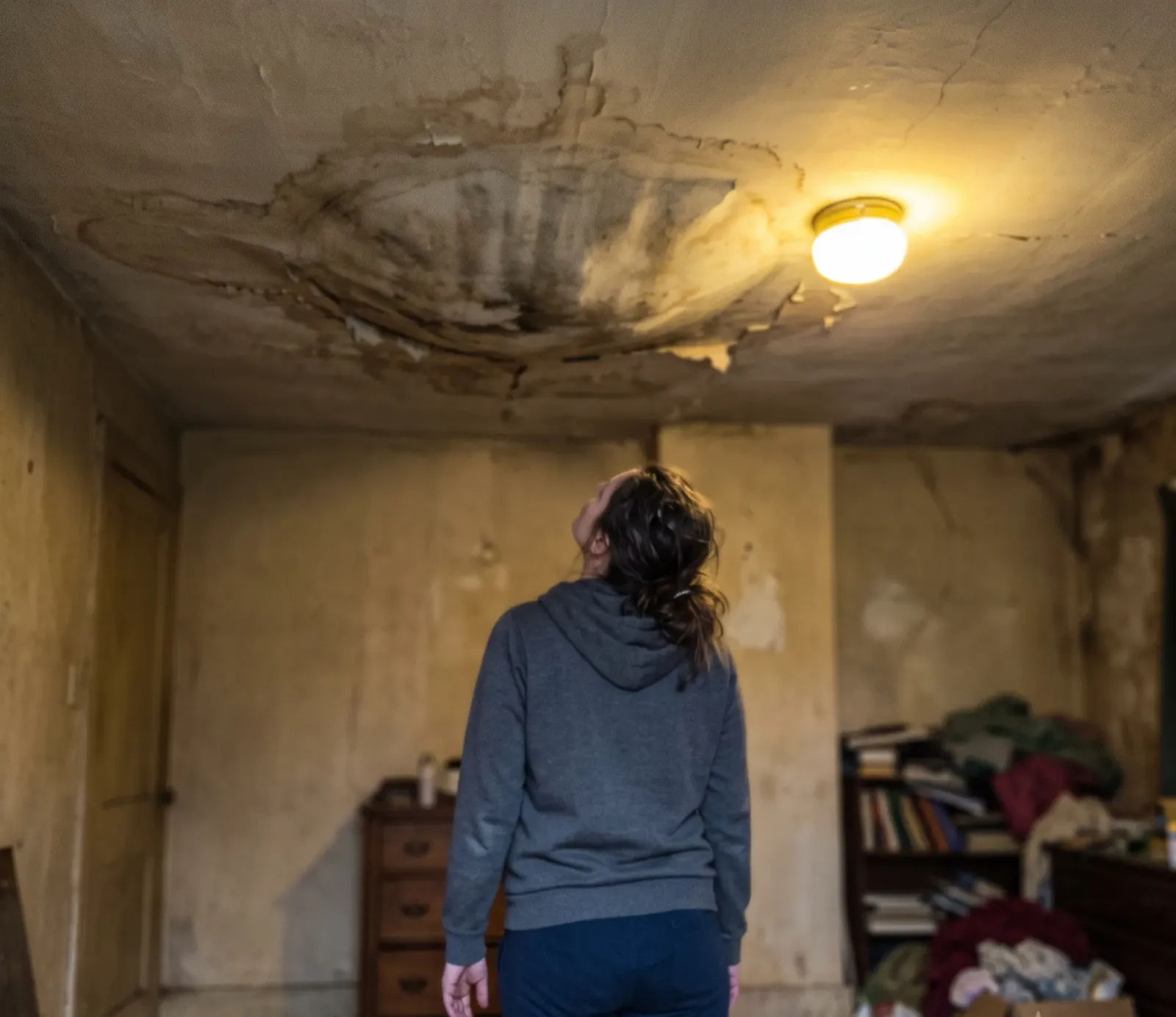
Wind-driven rain finds a way in that ordinary rain never does. It gets pushed sideways past flashing, under shingle tabs already lifted by a gust, and through a window that has sealed fine for years. After a severe thunderstorm moves through Atlanta, the first sign is often a stain spreading across a ceiling in a room with no obvious roof damage visible from the ground, which is exactly why a same-day look from the attic side matters.
A tree or limb through the roof deck or a wall is its own category, separate from wind alone. Straight-line wind events snap or drop trees onto structures across Atlanta's older, tree-heavy neighborhoods, and the impact usually opens the envelope in a way water follows within the same storm. Board-up and tarping have to happen before the next rain, not after, because a second storm through an open roof turns a repair into a rebuild.
Shingle uplift is easy to miss from the ground and easy to confirm from a ladder: tabs bent back, torn loose, or missing outright after a gust event. Left alone, an area of uplifted shingles keeps leaking every time it rains, even lightly, long after the storm that caused it has passed. Documenting that damage while it is fresh also matters for the insurance side of the claim.
The first call covers what is visibly damaged and what the immediate safety concerns are, so the right response, tarping, board-up, or extraction, gets prioritized before anyone arrives on site.
Open roof sections and broken windows get tarped or boarded first, since stopping further water and weather entry matters more than anything else in the opening hours after a storm.
Standing water gets extracted and the affected areas are set up for structural drying, with moisture readings tracked to confirm the space is actually drying out, not just looking dry.
Damage gets documented and organized in a way that supports the insurance claim, with the wind-versus-water distinction noted clearly, since that is usually the point an adjuster focuses on.
Older roof decking in Atlanta's tree-heavy neighborhoods gets tested hard when a limb comes down in a severe thunderstorm, and the ridge-and-valley terrain means wind can funnel unevenly block to block. Once wind-driven rain gets past a torn roof or a broken window, it moves into attic insulation and ceiling framing fast, and Atlanta's summer humidity slows the drying afterward. A house that looks fine from the curb can still be holding standing water in a wall cavity a day later.
Atlanta's ridge-and-valley terrain moves runoff fast once a storm drops real rainfall, and a roof or window breach during that kind of event means water is arriving under real volume and real speed, not a slow drip. Crews responding after severe weather here treat the first hours as extraction and drying time, not just patch time, because standing water left sitting in a humid Atlanta summer starts supporting mold within a day or two.
Wind is the part of a severe thunderstorm or straight-line wind event most homeowners' policies pick up without argument: shingle uplift, roof decking torn open, a window driven in by a tree limb. Water that follows that opening in is covered as a direct result of the wind. Water that simply rises off saturated ground and finds its way toward a foundation is a different category, carved out under the flood exclusion in most standard policies. An adjuster on an Atlanta storm claim is trained to draw exactly that line, and it is worth understanding before the call.
Older intown lots near Virginia-Highland or Candler Park often mean crawl space or basement access, which changes labor time versus a slab job near the BeltLine. Clay soil under most of Atlanta holds water at grade, so drying charges can extend if runoff kept feeding the same spot.
| Response Time | Coverage Area | Availability |
|---|---|---|
| Once materials are wet past saving, removal and disposal are priced by what has to come out: drywall, baseboard, flooring, sometimes cabinetry. A finished basement in Ansley Park with carpet and drywall costs more to demo than an unfinished crawl space near Nancy Creek with exposed framing and no wall coverings. | Water moves through Atlanta on its own terms. The clay under neighborhoods like Grant Park and Virginia-Highland holds moisture near the surface instead of letting it pass, so a hard rain along Peachtree Creek or near the Chattahoochee can back up against an older foundation within hours. Add a hilly street grid and aging pipe in parts of the city, and a single storm raises several separate questions about where the water actually came from. | an estimated $2040–$12600 |
| Tear-out costs scale with the materials affected, not the square footage alone, since removing tile is a different job than pulling wet carpet pad. A kitchen near Inman Park with water-damaged cabinets runs higher than a bare storage room in the same house with only a concrete floor to deal with. | Runoff in Atlanta doesn't soak into red clay the way people expect; it perches and pushes against a foundation instead. That's why a slab off Peachtree Creek and a crawl space near Utoy Creek can flood the same afternoon for the same reason. The licensed pros we connect you with read a house's grade and drainage before they open a wall, not after. | an estimated $2400–$18000 |
| Demolition of ruined materials is priced item by item: baseboard by the foot, drywall by the square foot, flooring by type. A hardwood floor pulled up in a Poncey-Highland bungalow is priced differently than vinyl plank in a newer build near the Atlanta BeltLine, since labor and disposal weight both change. | Water sitting under a Grant Park bungalow or seeping into a Virginia-Highland crawl space behaves differently depending on the house, the slope, and how long it sat before anyone noticed. The licensed pros we connect you with bring meters that read dampness behind walls and under flooring near Peachtree Creek, then set drying equipment to match what those readings show, not a guess. | an estimated $3600–$28800 |
| The removal stage costs more when insulation is involved, since wet insulation behind drywall in an older Cabbagetown home has to come out along with the wallboard, not just the surface material. A slab home near Buford Highway with no wall insulation to remove is a comparatively smaller demo job. | Water sits differently depending on where a house stands. A crawl space near Peachtree Creek holds moisture longer than a slab off Cascade Road, and a basement near Nancy Creek behaves nothing like one in Vinings. The licensed pros we connect you with read the property first — soil, grade, foundation type — before deciding how a job in Atlanta actually gets dried. | an estimated $5760–$48000 |
Drying time changes the bill more than most homeowners expect. Atlanta's summer humidity slows structural drying, so a job started fast near Peachtree Creek often costs less than one left sitting, since materials pulled out early beat materials replaced after mold sets in.
Usually, yes, if the damage is a direct result of wind, such as a tree limb through the roof or shingles torn off in a gust. What is not usually covered is water that rises from the outside as surface flooding, since that falls under a flood exclusion on a standard policy. An adjuster will look at what caused the opening, wind or water, since that distinction decides the claim.
Not automatically. A homeowners policy generally pays for damage the wind itself caused, like a tree limb through a roof or a window blown in during a severe thunderstorm, and the rain that entered through that opening. It typically will not pay for water that rose from the ground and worked its way toward a foundation separately, since that falls under the flood exclusion most policies carry. An adjuster looks at how the water got in, not just that it did, so keep the two apart in your own notes and photos.
It can, and it often does when a storm brings both. A downed tree can open the roof deck at the same time wind-driven rain is being forced through nearby seams and flashing, so a single event can produce damage from both causes on the same structure. That is part of why documenting the sequence of what happened matters for the claim.
Board-up and tarping are meant to stop the damage from getting worse, not to fix the roof or wall. A tarp over torn decking and plywood over a broken window keep wind-driven rain out during the next round of Atlanta thunderstorms, but the structural drying, insulation, and any rebuild still need to happen afterward. Expect the emergency mitigation crew to document the damage first, since that record is what an adjuster will want to see before the repair estimate is written.
Atlanta rarely sees a true hurricane, since it sits far enough inland that tropical systems are almost always well below hurricane strength by the time any effect reaches the city. What does reliably cause storm damage here is severe thunderstorms and straight-line wind, which can be just as capable of tearing off shingles or dropping a tree as a weaker tropical remnant passing through.
Tornado risk is real in the Atlanta area; both Fulton and Cobb counties have recorded more than twenty tornado touchdowns since 1950. Tornado damage tends to be more concentrated and severe along a narrow path, compared to the broader, more even damage pattern from straight-line wind across a wider area during a severe thunderstorm.
Basements near Grant Park and Inman Park sit on lots that slope hard toward the street, so a heavy storm sends water downhill and it collects where the foundation meets lower ground. Atlanta's clay slows drainage further, which is why the same address can flood twice in one wet month.
Not every house handles water the same way. A slab home near West Midtown dries differently than a walkout basement in Druid Hills, and a vented crawl space near Peachtree Creek holds humidity longer than an encapsulated one. The licensed pros we connect you with check the structure first, then decide how fast drying needs to happen before mold becomes the bigger problem.

The shutoff valve, the breaker, the furniture legs, the photo record: a short, ordered list of what to do with your own hands in an Atlanta home before anyone else gets there.
Read article
Before cleanup starts, a few minutes with a phone camera can make or break a claim. Here's what to photograph, film, and log in an Atlanta home before anyone touches the damage, from wide shots to serial numbers.
Read article
Atlanta sits on red clay over saprolite, soil that drains slowly and shrinks back from a foundation in dry weather. Here's what that means for grading, downspouts, and telling seepage apart from real structural movement.
Read articleEvery water loss in this city carries its own path, its own materials, and its own clock, so a page like this can only describe the general shape of the work. For the specifics of your address near Virginia-Highland, East Atlanta, or wherever you are calling from, the licensed local pros in this network can walk the affected rooms, explain what they find, and lay out the drying plan before anything starts.
Call (404) 496-7950