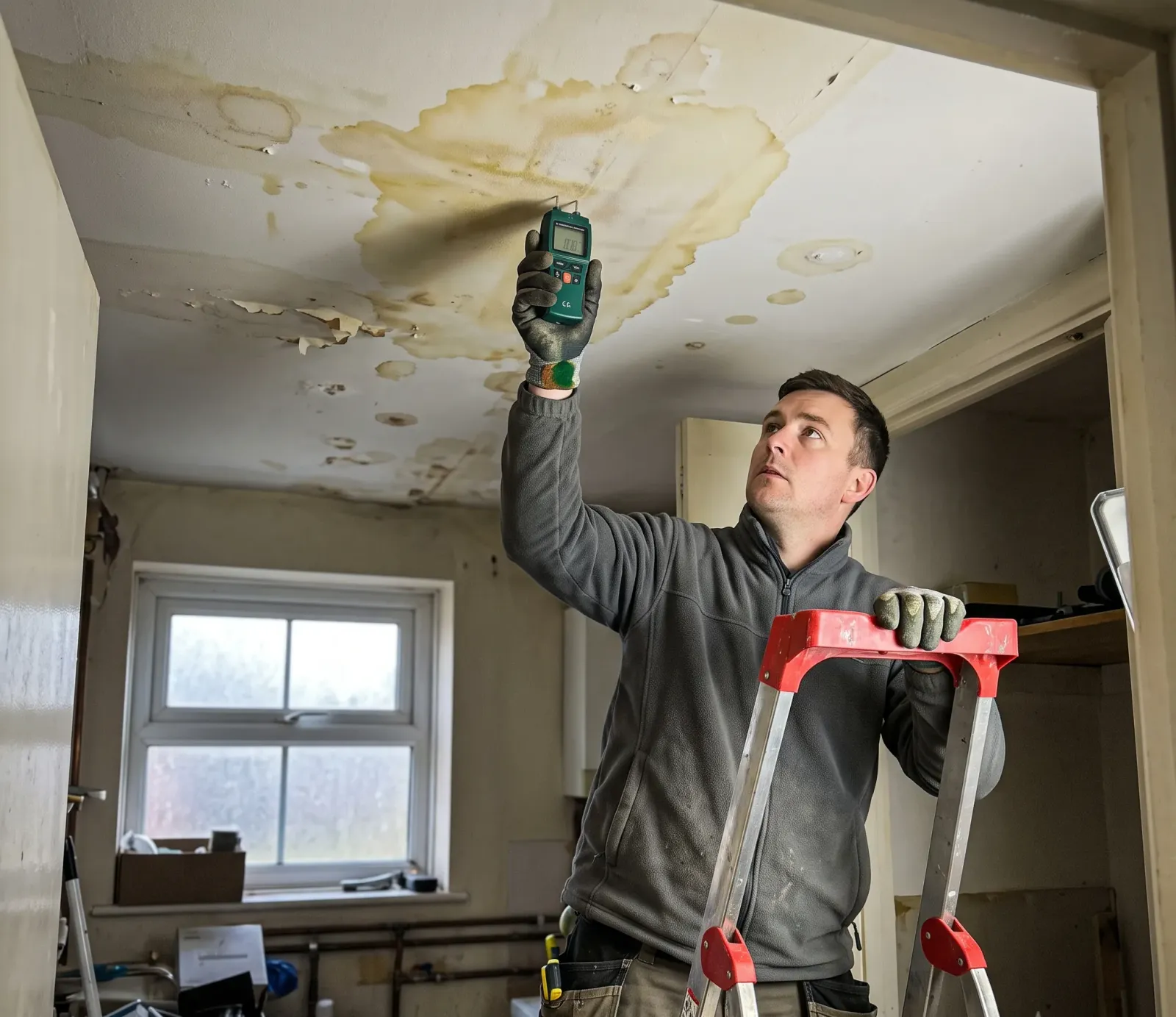
After a water event in an Atlanta home, the question that decides everything is whether the materials are actually dry, not whether they look dry or feel dry to the hand. Drywall and framing can seem fine on the surface days before they release the water trapped inside, especially with the humid air common here from May through September. Moisture meters exist to answer that question with a number instead of a guess, and the licensed pros you connect with rely on them to know when a job is genuinely finished rather than just quiet.
Two Kinds of Meter
A pin meter uses two small penetrating probes pushed into the material to read resistance between them, which correlates to moisture content at that exact depth. A pinless meter instead uses electromagnetic sensing pressed flat against the surface to scan a wider area without marking it. Pin meters give a more precise reading at a chosen depth; pinless meters cover more ground quickly and leave drywall or trim undamaged. Most drying jobs around Atlanta use both, pinless for the initial sweep and pin readings to confirm anything the sweep flags.
What the Numbers Mean
Not every meter on a drying job works the same way. Pinless models scan through the surface with a sensor pad, useful for a quick pass over a hardwood floor in Virginia-Highland without leaving marks. Pin-style models push slender points into the material for a reading at a specific depth, which matters more once drywall or subfloor is open. Technicians typically take a reading on unaffected material elsewhere in the house first, so the numbers from the wet area mean something instead of standing alone.
The Reference Reading
A moisture meter reading is not a percentage of water by weight unless the tool is calibrated to that specific material. Most pinless meters instead give a relative scale, a number with no unit meant only for comparing one reading against another on the same wall. Wood-based meters often display a wood moisture equivalent, a standardized figure that assumes the material is actually wood. Reading a number off a meter means nothing on its own; it only means something once it is measured against something else in the same building.
Why One Standard Fails
Before drying equipment goes in, the technician takes a reading from an unaffected material of the same type elsewhere in the house, a baseboard in a dry room or a stud from a wall the water never reached. That number becomes the reference reading, the baseline this specific house is judged against rather than a number from a textbook. Every material has its own normal moisture level depending on its age, its species if it's wood, and the humidity it has lived in, so a citywide standard number would tell an Atlanta home very little.
Setting the Dry Standard
A single fixed number cannot serve as a dry standard across every house, because material density and material history change what a normal reading looks like. A century-old floor near Grant Park has absorbed decades of ambient humidity into its grain in a way a floor in a newer build off Peachtree Industrial Boulevard has not. Treating both against the same fixed threshold would call one falsely wet and the other falsely dry. The baseline reading from that specific house's own unaffected material is what makes the comparison fair.
Reading The Relative Scale
The dry standard for a given drying job is simply the reference reading, sometimes with a small margin added, and drying continues until the affected material's reading comes back down to meet it. This is why a drying job cannot be timed by the calendar alone. Two rooms with identical equipment running the same number of days can finish on different schedules because their reference readings and their starting saturation were different. The meter is what tells the technician the job is actually done, not a fixed number of days on a chart.
Density Changes the Reading
During an active drying job, moisture readings get taken daily on the same materials in the same spots, so the numbers can be compared day over day rather than read in isolation. A reading that drops steadily shows the equipment is working. A reading that plateaus while the air handlers keep running usually means water is trapped somewhere the surface reading cannot see, often behind a wall or under flooring, and it is a signal to look further rather than to keep drying on faith.
Why Calibration Still Matters
Material density affects how a meter reads even when moisture content is identical, which is part of why a raw number cannot be compared across different materials. Dense old-growth lumber found in some of Atlanta's older housing stock reads differently than newer, less dense framing lumber, even at the same true moisture content. This is another reason the reference reading has to come from the same material in the same house rather than from a chart, and why a technician moving between a century home near Inman Park and new construction resets expectations each time.
Why This Matters to You
A meter that has not been checked against a known reference can drift over time and quietly return numbers that are consistently a little high or a little low. Calibration checks compare the meter's reading against a fixed test block with a known value, and a meter that fails that check gets adjusted or replaced before it is trusted on a job again. This matters more on a drying job than it sounds, because every decision after the first reading, the reference number, the daily comparisons, the call to stop, depends on that first number being honest.
Reading the Result Right
For a homeowner, the practical value of all this is simple: drying equipment can be pulled out with confidence instead of a guess, because the numbers say the material has returned to what is normal for that house rather than to what looks or feels dry. Stopping too early in a humid Atlanta summer leaves moisture behind that ambient conditions will not finish evaporating on their own, and that is a common path into the mold risk covered on the structural drying side of this work.
Reading The Meter Correctly
None of this replaces judgment. A meter gives a number, and a technician reads that number against the reference, the material type, and how the room has behaved over the preceding days. Two rooms can show the same reading and still need different treatment depending on what is behind the wall or under the floor. The tool tells you where you stand; deciding what that means for an Atlanta home still comes down to someone who has read enough of these numbers to know when one does not add up.
Dealing with this in your home?
A basement near Ormewood Park can sit dry for a year, then take on water the first time a real downpour hits. Atlanta's red clay sheds rain rather than soaking it in, so water piles up against a foundation wall fast, especially on lots that slope toward Intrenchment Creek. This post covers what that pattern actually means for a home.